In the video below my mentor Rachel Cosgrove makes a great presentation to a group of females about the 3 breakthrough's needed to change your shape. Rachel was doing this talk as a tour for her great book The Female Body Breakthrough.
Rachel makes 3 points that need to be in balance for you to reach the shape you are after, Mindset (having a goal), Exercise (resistance training) and Nutrition (sensible eating and lifestyle changes).
If you have these 3 breakthrough's in balance you will not only change your shape but also keep these changes for good!
Sunday, 28 March 2010
Monday, 15 March 2010
Normal Weight, Yet Still Obese?
The below video appeared on Good Morning America in January, its about the Skinny Fat syndrome which is very interesting.
http://abcnews.go.com/video/playerIndex?id=9674189
As you can see in the video what most people are doing wrong is focusing on the scales and not on how they fit into there clothes or look in the mirror.
Fat Or Muscle?
Lets put it another way, would you like 5lbs of muscle or 5lbs of fat on your body, they both weight the same so on the scales you would still be the same weight. But would you look the same?
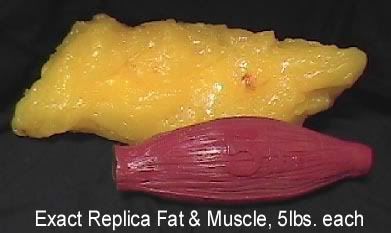
As you can see in the image above the 5lbs of fat (in yellow) would take up more room in your body frame compared to the 5lbs of muscle, making you look slimmer even though you still weighed the same weight.
The Common Mistake?
Most people believe that hitting the cardio trail (walking, running, cycling, etc) is the way to the new you. Yes, you might lose weight to start with because of the increase in activity if you haven't done any exercise of late, but as you can see in a previous post i made Acceptable in the 80's part 1 the research isn't behind steady state cardio for fat loss.
As Monica said in the video the KEY to losing fat and completely changing your shape permanently is resistance training.
Resistance training helps you to build lean muscle tissue, which in turn helps to speed up you metabolic rate. Over the years your metabolic rate slows down as you loss lean muscle tissue and causes you to put on weight and fat. This is one reason to give resistance training a go if you don't already.
Another reason to give resistance training a go and keep off the fat, is for health benefits. As it mentioned in the video the areas that you hold your body fat can be very dangerous to health. The belly region in men and women can be very dangerous to health with causes being heart disease, stroke, type 2 diabetes, high blood pressure, to name a few.
In Conclusion
STOP focusing on the scales and start focusing on your shape, add the resitance training to your program and see the changes, and even better than that take pictures over the week and see your shape change and feel better in your clothes.
http://abcnews.go.com/video/playerIndex?id=9674189
As you can see in the video what most people are doing wrong is focusing on the scales and not on how they fit into there clothes or look in the mirror.
Fat Or Muscle?
Lets put it another way, would you like 5lbs of muscle or 5lbs of fat on your body, they both weight the same so on the scales you would still be the same weight. But would you look the same?
As you can see in the image above the 5lbs of fat (in yellow) would take up more room in your body frame compared to the 5lbs of muscle, making you look slimmer even though you still weighed the same weight.
The Common Mistake?
Most people believe that hitting the cardio trail (walking, running, cycling, etc) is the way to the new you. Yes, you might lose weight to start with because of the increase in activity if you haven't done any exercise of late, but as you can see in a previous post i made Acceptable in the 80's part 1 the research isn't behind steady state cardio for fat loss.
As Monica said in the video the KEY to losing fat and completely changing your shape permanently is resistance training.
Resistance training helps you to build lean muscle tissue, which in turn helps to speed up you metabolic rate. Over the years your metabolic rate slows down as you loss lean muscle tissue and causes you to put on weight and fat. This is one reason to give resistance training a go if you don't already.
Another reason to give resistance training a go and keep off the fat, is for health benefits. As it mentioned in the video the areas that you hold your body fat can be very dangerous to health. The belly region in men and women can be very dangerous to health with causes being heart disease, stroke, type 2 diabetes, high blood pressure, to name a few.
In Conclusion
STOP focusing on the scales and start focusing on your shape, add the resitance training to your program and see the changes, and even better than that take pictures over the week and see your shape change and feel better in your clothes.

Monday, 8 March 2010
3 Dirty Tricks The Supermarkets Use To Get Us To Buy More!
1. Size matters
2 .Special offers
How to get what you want!
Make a list.
This is the easiest way to get what you want. Sit down before you go shopping and plan your week ahead for every meal, it sounds like a bit of hassle but once you get onto it it will only take about 15 minutes and it will mean that you stick to eating plan and reach your goal, also it will mean that you will not spend anymore than you need too.
Ask yourself the question?
You have to ask yourself "do i really need it?" This is where the list would come in handy as you know that you need and if there is an offer on, is it the quanity you need, if so, you are on a winner.
Try making a list the next time you go shopping to see if it pays for you!
You might think you'll save yourself some pennies if you buy larger packs of goods. After all, generally speaking, buying in bulk is supposed to be cheaper.
But according to research from mySupermarket.co.uk, shoppers could be paying up to 46% more by opting for bigger packs. For example, an 800g jar of Hellmann's mayonnaise was found to be 33% (99p) more expensive than buying two jars of 400g mayonnaise.
The best way to avoid this is to always check product details before buying – it's a really good idea to check the price per weight.2 .Special offers
Special offers such as 'buy one get one free' deals can be very tempting. But while in some cases these can help to slash your food bills, they don't always provide the best value for money.
Often you'll find the very best deals are on perishable items such as fruit and vegetables. So unless you can guarantee you'll eat two bags of satsumas in a few days, you may find you end up throwing a lot of food away.
What's more, if you head down to your local greengrocers or market, you will probably find you can buy the same product even cheaper. Or simply grow your own!
Similarly, be wary of deals such as 'buy one get one half price' and 'two for £3' – if you don't actually need to buy two, don't get too sucked in. Some supermarkets cunningly raise prices one week and then reduce them the next so that they can claim a discount. So don't buy more simply because you can.
Do you ever find yourself wondering what's at the top of the supermarket shelf? The one you can't quite reach? Supermarkets will often put the most profitable items at eye level so they are easy to find, while the cheapest items will be at the very top or very bottom of the shelf. This means you may need to be prepared to do some hunting if you want the best bargains.
Similarly, you may find the most expensive products, such as electrical goods, are placed near the entrance to the supermarket. Meanwhile, the cheaper basic foods will be towards the exit – so you'll have to pass the tempting electrical products to get to them.How to get what you want!
Make a list.
This is the easiest way to get what you want. Sit down before you go shopping and plan your week ahead for every meal, it sounds like a bit of hassle but once you get onto it it will only take about 15 minutes and it will mean that you stick to eating plan and reach your goal, also it will mean that you will not spend anymore than you need too.
Ask yourself the question?
You have to ask yourself "do i really need it?" This is where the list would come in handy as you know that you need and if there is an offer on, is it the quanity you need, if so, you are on a winner.
Try making a list the next time you go shopping to see if it pays for you!
Sunday, 14 February 2010
Tips From Olympians To Achieve Your Goals

With the Winter Olympics just started this weekend in Canada, this is the build up of at least 4 years training for the athletes. They have arrived at this point in their best physical and mental shape for the games.
Now, 4 years is quite a long time to stay focused to achieve their goal. We are now half why through February and most people have failed with there New Years Resolutions. So how do these athletes keep focused for so long? And what can they teach us to achieve are own goals!
We will go over 5 strategies that world class athletes use, and that you can use to reach your health and fitness goals. So, lets get started........
- Know What You Want To Achieve And When!

The athletes have a DEFINITE final destination, an end point for there goal. This is the key in this strategy a definite destination, you have to have a date of completion, an end point.
First you pick the goal (say lose a stone) and then you have to pick a date, an end for this goal, this one thing makes it set in stone giving you a final destination to aim for. Its like the GPS in your car you have to put in the destination first before it will give you direction to this destination.
Rule number 1 - Decide what you want to achieve and then fix a date to achieve it by, then write it down as it makes it real.
2. Why You Want To Achieve This Goal!
For the athletes this is to prove that they are the best at their chosen sport, to stand on top of the podium and be crowned Olympic Champion. Also to have the admiration of your country, but probably most of all is to prove to themselves that thay are the best at their chosen sport.
To find out the Why of your goal you have to ask yourself some probing questions. You have to find the real emotional reason that you want to achieve your goal. You can't just say that you want to lose a stone because you want to look better. Deep down inside you there will be the real reason like, i want to lose a stone because i don't feel comfortable with my shape to ask that person out, or i wouldn't feel comfortable for him to see me naked, i don't feel comfortable to be in a bikini at the beach on holidays. You know the real reason deep inside, if you can really tap into this emotional side of your goal it will drive you to really succeed in reaching your goal.
Rule number 2 - Find your emotional trigger, the real desire to make the changes to achieve your goal.
3. Knowing and paying the price for your goal!
With every goal you set in your life there is a price to pay to achieve it, for the athletes it is getting up early to train, never missing a training session, eating the right foods at the right times, missing that party because they have training or a competition, and so on.
Do you know what it will cost to achieve your goal?
Eating better, increasing your activity levels, maybe even the financial cost of hiring a personal trainer, possibly having a few less drinks at the weekend, etc.
Whatever it is, be honest enough to appreciate what you have to change. At the very least you can then decide whether the cost is worth taking for that goal which was so important to you a few minutes ago.
Rule number 3 - Know what it will take to achieve your goal the changes you have to make and pay the price to achieve your goal.
4. Tracking Your Progress!
You have to know how close or how far you are off your goal so you can adjust and get back on track. The athletes have many feedback methods, but the most important of these is competitions they have over the 4 year period leading up to the Olympics. The athletes can see how they are performing competition to competition and make adjustments to there training and eating. The competitions also help to break the main goal of the Olympics down in smaller goals to keep them focused for longer.
So, after you have picked your goal and set that date to reach the goal, found the real reason to complete the goal, you have to now track the goal to see if you are going to reach the goal by the time you have set for yourself.
Step 1 - Break down your goal into more manageable chunks, ie if your goal is to lose a stone in 16 weeks are you on track at 8 weeks and 4 weeks.
Step 2 - Track your eating. Keeping a food journal (an honest food journal, you are only lying to yourself) gives you an idea of any changes that you might need to make to get your progress back on track for your goal.
Step 3 - Track your training. This is training sessions complete, and progressions you have been making in your training. This way you can see if you have been performing enough training sessions (activity to burn calories) or that you have been pushing yourself to make progress in your training.
Rule number 4 - Break your goal down into mini goals, track your progress so you can make changes to reach your goal.
5. Believe You Can Do It!
For some of the athletes they have setbacks like injuries, but they believe that they can come back form the injury and compete at there best in the games, and many do because they have that emotional desire to achieve there goal.
You have to believe that you can achieve your goal also. You are going to have pitfalls too, like - missing the training sessions, have that meal thats not on your plan, having to much to drink and even injuries. But these are mostly minor setbacks and you just have to get back on the plan asap.
Belief is knowing no matter what setbacks comes up in your plan that you can make it to the finish line, (that date you have set for yourself) keep a positive outlook and adhere to rules number 1 -4 and you will reach your goal.
Rule number 5 - Believe you can do it no matter what the setback.
If you have set yourself a goal in the past and have never really reached the desired outcome then give the 5 rules above an honest effort and that goal could be closer than you imagine.
Sunday, 7 February 2010
Acceptable in the 80's - Part 2
In Acceptable in the 80's part 1, we talked about training and what old training methods have been debunked by research for fat loss and gave you a few new methods to speed up the fat burning process. So in part 2 of acceptable in the 80's we will be looking at nutrtional strategies that have been debunked by reseach and improved strategies for fat loss success.
So lets get started..........
ACCEPTABLE IN THE 80'S NO 2 - HIGH CARB, LOW FAT DIETS
The thinking in the 80's was that if we didn't eat fat we wouldn't be fat, sounds sensible.
Well Walter Willett, Chair of the department of nutrtion at Harvard School of Health, had this to say:
"The idea that all fat is bad for you, the exclusive focus on adverse effects of fat, may have contributed to the obesity epidemic.... The emphasis on total fat reduction has been a serious distraction in the efforts to control obesity and improve health in general."
The Different types of fat
There are 4 different types of fat - Monounsaturated, Polyunsaturated, Saturated and tran's fat which can be further broke down into good and bad fats.
Monounsaturated fats (good fats)
Monounsaturated fats are said to help reduce cholesterol, blood pressure and help with the control of diabetes.
Polyunsaturated fats (good fats)
Polyunsaturated fats help to improve immune function and help to protect against sudden death from heart disease.
Polyunsaturated fats can be broken down into 2 catagories:- omega 3 and omega 6.
Saturated fats (bad fats)
Saturated fats raise the risk of heart disease and stroke, as well as cholestrol. In fact they are twice as potent at raising cholestrol as polyunsaturated fats are at lowering cholestrol levels.
Tran's fats (bad fats)
Trans fats increase the risk of heart disease and stroke.
Omega 3 fish oil and fat loss
One of the reasons why we where told not to eat fat in the 80's was that there was little human data available about fish oil and fat loss until the late 1990's.
Six male subjects were fed a control diet ad libitum (as much food as they wanted) for 3 weeks. 12 weeks later, they were given a diet with the same amount of calories, only this time with 6 grams per day of fish oil replacing 6 grams of other dietary fat. During both periods, the researchers measured energy intake, resting metabolic rate, basal substrate oxidation and body fat (using dual x ray absorpitometry, a sophisticated and highly accurate way to measure body fat composition).
The fish oil was given to the experimental group as 8 capsules of 750mg (2 at breakfast, 3 at lunch, and 3 at dinner). This amounted to 1.1 grams of DHA and 0.7 grams of EPA, for a total of 1.8 grams of long chain omega 3 fatty acids per day.
Food intake was carefully controlled, with all meals deing ingested in the metabolic laboratory. Food was weighed and cooked by a dietician before being served, and leftover food was weighed and accounted for in the calculation of calorie intake.
The subjects body weight did not change, but there body composition did: the fish oil group lost 2 pounds of fat compared to 0.7 pounds of fat in the group without fish oil. The researchers noted however, that these differences did not reach statistical significance.
There was also a difference in resting metabolic rate: The resting metabolic rate of the fish oil group was 1775 kcal per day, compared to 1710 kcal per day for the no fish oil group.
Of most significance, the rate of fat oxidation in the fish oil group increased by 25% over the group that did not take fish oil.
Low carb diets and fat loss
As you can see not all fats are bad for you, and some fats can even help with fat loss. But there was another side to the nutritional strategy of the 80's it was high carbohydrate intake. This is probably the worst part of the 80's nutritional strategies, because of are own recommendations (6-11 servings of refined carbs in the food pyramid) we created Type 2 diabetes.
The study was entitled the A TO Z Weight Loss Study (Atkins, Traditional, Ornish, Zone)
Briefly:
311 people were randomly assigned to a diet for 12 months.
Results after 12 months:
Atkins Diet: -4.7kg (10.4lbs)
Zone Diet: -1.6kg (3.5lbs)
Learn Diet (traditional diet recommendations -- low fat high carbs) : -2.6kg (5.7lbs)
Ornish Diet: -2.2kg (4.8lbs)
The diet essentially looked at different gradations of carbohydrate intake on weight loss.
Basically -- the Atkins diet (low carb, high fat, high protein diet) outperformed the other diets VERY significantly in terms of fat loss. There was no statistically significant difference in fat loss between the other groups.
Important to note is that total energy intake was NOT different among the diet groups at the baseline measure or any subsequent point -- they all ate the same total calories. However, over time all four groups significantly decreased caloric intake over the course of the study - they all did eat less to generate fat loss - but they all ate the same amount.
Weight loss after 12 weeks was as follows:
4.6lbs for high carb no exercise group
8.8lbs for high carb with exercise group
10.1lbs for the high protein-low carb -no exercise group
and 15.5 lbs for the high protein, low carb with exercise group.
What's really interesting is that the high protein, low carb group was superior for weight loss over high carb with exercise. And it was 75% superior when combined with exercise.
In conclusion
I hope over the 2 articles that i have given you some ideas on more effective approaches to fat loss training and eating. Lower your refined carb intake and up your good fat intake. Start with a good resistance training program then add interval type training sessions. Follow these ideas and you will be on the road to fat loss success.
PS. I would like to thank my mentor Alwyn Cosgrove and Tom Venuto for bringing these research studies to light for fitness professionals all over the world.
PPS. As a tribute to Calvin Harris and the song Acceptable in the 80's that started the idea of the article in my head, please watch the video below
So lets get started..........
ACCEPTABLE IN THE 80'S NO 2 - HIGH CARB, LOW FAT DIETS
The thinking in the 80's was that if we didn't eat fat we wouldn't be fat, sounds sensible.
Well Walter Willett, Chair of the department of nutrtion at Harvard School of Health, had this to say:
"The idea that all fat is bad for you, the exclusive focus on adverse effects of fat, may have contributed to the obesity epidemic.... The emphasis on total fat reduction has been a serious distraction in the efforts to control obesity and improve health in general."
The Different types of fat
There are 4 different types of fat - Monounsaturated, Polyunsaturated, Saturated and tran's fat which can be further broke down into good and bad fats.
Monounsaturated fats (good fats)
Monounsaturated fats are said to help reduce cholesterol, blood pressure and help with the control of diabetes.
Polyunsaturated fats (good fats)
Polyunsaturated fats help to improve immune function and help to protect against sudden death from heart disease.
Polyunsaturated fats can be broken down into 2 catagories:- omega 3 and omega 6.
Saturated fats (bad fats)
Saturated fats raise the risk of heart disease and stroke, as well as cholestrol. In fact they are twice as potent at raising cholestrol as polyunsaturated fats are at lowering cholestrol levels.
Tran's fats (bad fats)
Trans fats increase the risk of heart disease and stroke.
Omega 3 fish oil and fat loss
One of the reasons why we where told not to eat fat in the 80's was that there was little human data available about fish oil and fat loss until the late 1990's.
- One of the earliest studies on fish oil and fat loss in humans was published in 1997 in the International Journal of Obesity (Couet 1997). The purpose of the study was to investigate the effect of substituting fish oil for other visible dietary fats on body fat mass and substrate oxidation in healthy adult humans.
Six male subjects were fed a control diet ad libitum (as much food as they wanted) for 3 weeks. 12 weeks later, they were given a diet with the same amount of calories, only this time with 6 grams per day of fish oil replacing 6 grams of other dietary fat. During both periods, the researchers measured energy intake, resting metabolic rate, basal substrate oxidation and body fat (using dual x ray absorpitometry, a sophisticated and highly accurate way to measure body fat composition).
The fish oil was given to the experimental group as 8 capsules of 750mg (2 at breakfast, 3 at lunch, and 3 at dinner). This amounted to 1.1 grams of DHA and 0.7 grams of EPA, for a total of 1.8 grams of long chain omega 3 fatty acids per day.
Food intake was carefully controlled, with all meals deing ingested in the metabolic laboratory. Food was weighed and cooked by a dietician before being served, and leftover food was weighed and accounted for in the calculation of calorie intake.
The subjects body weight did not change, but there body composition did: the fish oil group lost 2 pounds of fat compared to 0.7 pounds of fat in the group without fish oil. The researchers noted however, that these differences did not reach statistical significance.
There was also a difference in resting metabolic rate: The resting metabolic rate of the fish oil group was 1775 kcal per day, compared to 1710 kcal per day for the no fish oil group.
Of most significance, the rate of fat oxidation in the fish oil group increased by 25% over the group that did not take fish oil.
- 2006, Czech researchers (kunesova, et al) from Charles University's obesity management centre in Prague. Took 20 severely obese women who were randomly assigned to either a very low calorie diet and placebo or a very low calorie diet with an omega 3 (EPA and DHA) supplement. The subjects also performed about 60 minutes daily of light physical activity.
- A study published in the International Journal of Obesity (Garulet 2006) showed for the first time in humans that omega-3 and omega-6 fatty acids were related to reduce fat cell size in certain lacations on the body. The same study showed that in contrast, saturated dietary fatty acids significantly correlated with an increase in fat cell size and number.
Low carb diets and fat loss
As you can see not all fats are bad for you, and some fats can even help with fat loss. But there was another side to the nutritional strategy of the 80's it was high carbohydrate intake. This is probably the worst part of the 80's nutritional strategies, because of are own recommendations (6-11 servings of refined carbs in the food pyramid) we created Type 2 diabetes.
- A study comparing different diets (Atkins, Zone, Learn and Ornish) was published in the Journal of the American Medical Association Vol 297 No.9 pp 969-977)
The study was entitled the A TO Z Weight Loss Study (Atkins, Traditional, Ornish, Zone)
Briefly:
311 people were randomly assigned to a diet for 12 months.
Results after 12 months:
Atkins Diet: -4.7kg (10.4lbs)
Zone Diet: -1.6kg (3.5lbs)
Learn Diet (traditional diet recommendations -- low fat high carbs) : -2.6kg (5.7lbs)
Ornish Diet: -2.2kg (4.8lbs)
The diet essentially looked at different gradations of carbohydrate intake on weight loss.
Basically -- the Atkins diet (low carb, high fat, high protein diet) outperformed the other diets VERY significantly in terms of fat loss. There was no statistically significant difference in fat loss between the other groups.
Important to note is that total energy intake was NOT different among the diet groups at the baseline measure or any subsequent point -- they all ate the same total calories. However, over time all four groups significantly decreased caloric intake over the course of the study - they all did eat less to generate fat loss - but they all ate the same amount.
Pilot 12-Week Feeding Weight-Loss Comparison: Low-Fat vs Low-Carbohydrate (Ketogenic) Diets," Abstract Presented at The North American Association for the Study of Obesity Annual Meeting 2003, Obesity Research, 11S, 2003, page 95OR.
- Greene, P., Willett, W., Devecis, J., et al.,
Three groups on different diets for 12 weeks:
Low fat/low cal (1800 cals per day) diet: Lost on average 17 lbs
Low carb/higher cal (+300) group: Lost on average 20 lbs.
- Meckling KA, Sherfey R
A randomized trial of a hypocaloric high-protein diet, with and without exercise, on weight loss, fitness, and markers of the Metabolic Syndrome in overweight and obese women.
Appl Physiol Nutr Metab. 2007 Aug;32(4):743-752.
The subjects were divided into two main groups - high carb (3:1 carb:protein) and low carb (1:1 carb: protein) and then subdivided into exercise (three times per week) and non exercise groups within each diet group.
Weight loss after 12 weeks was as follows:
4.6lbs for high carb no exercise group
8.8lbs for high carb with exercise group
10.1lbs for the high protein-low carb -no exercise group
and 15.5 lbs for the high protein, low carb with exercise group.
What's really interesting is that the high protein, low carb group was superior for weight loss over high carb with exercise. And it was 75% superior when combined with exercise.
In conclusion
I hope over the 2 articles that i have given you some ideas on more effective approaches to fat loss training and eating. Lower your refined carb intake and up your good fat intake. Start with a good resistance training program then add interval type training sessions. Follow these ideas and you will be on the road to fat loss success.
PS. I would like to thank my mentor Alwyn Cosgrove and Tom Venuto for bringing these research studies to light for fitness professionals all over the world.
PPS. As a tribute to Calvin Harris and the song Acceptable in the 80's that started the idea of the article in my head, please watch the video below
Wednesday, 27 January 2010
Simple Suppers

I was just watching Nigel Slater's show on BBC 1, Simple Suppers.
Tonights show was about new ways of cooking ingredients that just go perfectly together. It got me thinking about how to make food taste great without necessarily having to have rich (calorie dense) sauces.
I love to find recipes that are full of flavour and don't have very many ingredients so i thought that i would share a recipe with you to spice up your salmon dishes with very simple ingredients.
Asian Ginger Salmon
Ingredients
Olive Oil
350g (12oz) Salmon fillet
Salt and ground black pepper to taste
2 tablespoons low-sodium soy sauce
2 tablespoons water
2 tablespoons chopped fresh ginger (i have used ground ginger and it works well to)
Cooking
Heat a non-stick frying pan over a medium-high heat and add a drop of olive oil. Add Salmon and brown for 2 minutes. Turn, season the cooked side, then brown the second side for 2 minutes. Lower the heat and saute for 5 minutes. Combine the soy sauce, water and ginger in a small bowl. Remove the salmon from the pan, add the soy sauce mixture to the pan and cook for several seconds. Divide the salmon between 2 plates and spoon the sauce over the salmon.
Why not give it a try and see what you think.
Saturday, 16 January 2010
Acceptable in the 80’s – Part 1
This article all started when I first heard Calvin Harris song acceptable in the 80’s. It got me thinking about what was acceptable in the 80’s and isn’t anymore.
Was it big hair?

Was it shoulder pads?

No, in all fairness I was thinking about training and what was acceptable in the 80’s and not true anymore. So in this and the following article we are going to go over what was acceptable in the 80’s with training and nutrition, but is not true anymore. So lets get started.
Training
Acceptable in the 80’s number 1 – Aerobic training for fat loss
I don’t know if this one has actually gone away, as I keep getting asked questions like “is walking a good method to get in shape?” But the research is definitely debunking this myth.
In the 80’s we believed that endurance training (aerobic training) was the way forward in fat loss training. Fitness professional and researchers were looking at how much fat was being burned during the exercise session itself and not the effect the exercise had on the resting metabolic rate for the other 23 hours and longer, when your not working out. So I am going to put forward a case to debunk these methods and show you a superior method to burn more fat.
But first, what is the definition of aerobic training. Aerobic means "with oxygen", and refers to the use of oxygen in the body's metabolic or energy-generating process. Many types of exercise are aerobic, and by definition are performed at moderate levels of intensity for extended periods of time. So that long walk or run at a steady pace fall into this category.
Lets see what the research is saying about the effectiveness of aerobic training;
- A 1998 study (Int J Sport Nutr. 1998 Sep;8(3):213-22.) once compared the addition of 45 mins at 78% Max Heart Rate of aerobic training, 5 days per week to an already dieting population and found that it had no additional fat loss effect over dieting alone.
- A recent study from the University of Colorado (published in the Journal of Applied Physiology) had participants perform an hour long easy ride and monitored the "afterburn" - to see how much fat they burned post workout.
They didn't burn any more than they did if they hadn't exercised.
From the New York Times:
To their surprise, the researchers found that none of the groups, including the athletes, experienced “afterburn.” They did not use additional body fat on the day when they exercised. In fact, most of the subjects burned slightly less fat over the 24-hour study period when they exercised than when they did not.
- A study as regards running and long term adaptations to metabolism was released.
Williams PT, Wood PD.
The effects of changing exercise levels on weight and age-related weight gain.
Int j Obes (lond). 2006 Mar; 30(3):543-51.
The researchers undergoing the study (from the University of California, Berkeley), discovered that men and women who logged the same weekly mileage year after year – regardless of the amount – gained weight.
Case in point: even those who ran more than 40 miles a week were susceptible. “your metabolism slows a little more every year, so you need to increase activity levels as you age,” says study author Paul T. Williams, PH.D. “yet most people do the opposite.” Clearly the effects of aerobic exercise do little to offset this reduction in metabolism. And additional research also suggests that regular running improves your body’s exercise efficiency, meaning the same amount of activity burns fewer calories.
The researchers concluded that to avoid weight gain, male runners need to boost their weekly mileage by 1.7 miles per week, or approximately 88.4 miles per year, every year, with female runners having to boost their mileage by 2.4 miles per week or 125 miles per year, every year.
Conclusion: As you can see in the first 2 studies they add aerobic training to already dieting subject but none of them lost any additional weight compared to the diet only group. With the last study it showed how much more work a year you would have to do to keep in shape running, man that is a lot of extra miles a year, I’m getting tried just reading it!
So, Is their a better way?
Yeah, creating the afterburn effect!
What is afterburn?
EPOC or “excess post-exercise oxygen consumption” is defined scientifically as the “recovery of metabolic rate back to pre-exercise levels” and it’s generally used to describe the “afterburn” effect. A very simple way of thinking about EPOC is that when you do certain types of training you exert yourself beyond what your body is capable of handling (i.e. your body can’t keep up); it then uses the next 12, 24, or even 36 hours to ‘catch up’ metabolically. ‘Catch up’ = burning calories.
How do we create an afterburn effect?
Resistance or strength training as a superior method for fat loss and creating the afterburn effect;
Schuenke MD, Mikat RP, McBride JM.
Effect of an acute period of resistance exercise on excess post-exercise oxygen consumption (EPOC): implications for body fat management.
Eur J Appl Physiol 2002 Mar;86(5):411-7
This group looked at the effects of circuit weight training on EPOC. EPOC (Excess Post-Exercise Oxygen Consumption) is defined scientifically as the “recovery of metabolic rate back to pre-exercise levels”
The exercise routine consisted of three exercises (the bench press, the power clean and the squat), performed with 10RM loads as a circuit. The circuit was performed four times (i.e. twelve total sets) and took 31 mins.
EPOC was elevated for 38 hours post workout (possibly longer as this was when the researchers stopped measuring). The duration and magnitude of the EPOC observed in this study indicates the importance of the role of high intensity resistance training in a fat loss program.
Geliebter A, Maher MM, Gerace L, Gutin B, Heymsfield SB, Hashim SA.
Effects of strength or aerobic training on body composition, resting metabolic rate, and peak oxygen consumption in obese dieting subjects.
Am J Clin Nutr. 1997 Sep; 66(3): 557-63
Conclusion – in an isoenergetic comparison (the same calories consumed as burned in both groups), the strength training group lost significantly more fat than the aerobic training group. Additionally the aerobic training group lost significantly more lean body mass (muscle) than the strength training group.
Interval training as a superior method for fat loss and creating the afterburn effect;
The landmark study on this case is from Tremblay:
The premise of the study was to compare twenty (20) weeks of steady state endurance training and fifteen (15) weeks of interval training.
When comparing total calories burned the researchers found that the energy cost of the endurance training was 28661 calories, while the total calories burned in the interval training program was 13614 calories. In other words the interval training group burned less than half the calories of the endurance training group.
Despite its lower energy cost, the interval training program induced a more pronounced reduction in subcutaneous adiposity (fat tissue) compared with the endurance training program.
And when the researchers adjusted the results and corrected for difference in energy cost, the interval training group showed a NINE TIMES greater loss in subcutaneous fat than the endurance group.
Additionally the researchers noted that the metabolic adaptations taking place in the skeletal muscle in response to the interval training program appear to favour the process of fat oxidation.
Now this is something promising. With a shorter program (fifteen weeks compared to twenty weeks), and burning less calories each time, the interval training program group showed a bigger reduction in subcutaneous fat than the endurance program. And when the researchers adjusted the data to compare similar caloric expenditures the decrease in subcutaneous skinfolds was nine (9) times greater in the interval training group than in the endurance group.
The take home message!
Aerobics training might have been acceptable in the 80’s but with the new research and more coming out all the time backing it up, resistance training and interval training is the future of fat loss.
In part 2 of acceptable in the 80’s we will look at nutrition.
Subscribe to:
Posts (Atom)